Cold Plasma Activated Water (CPAW)
Vinod Patil
March 10, 2026
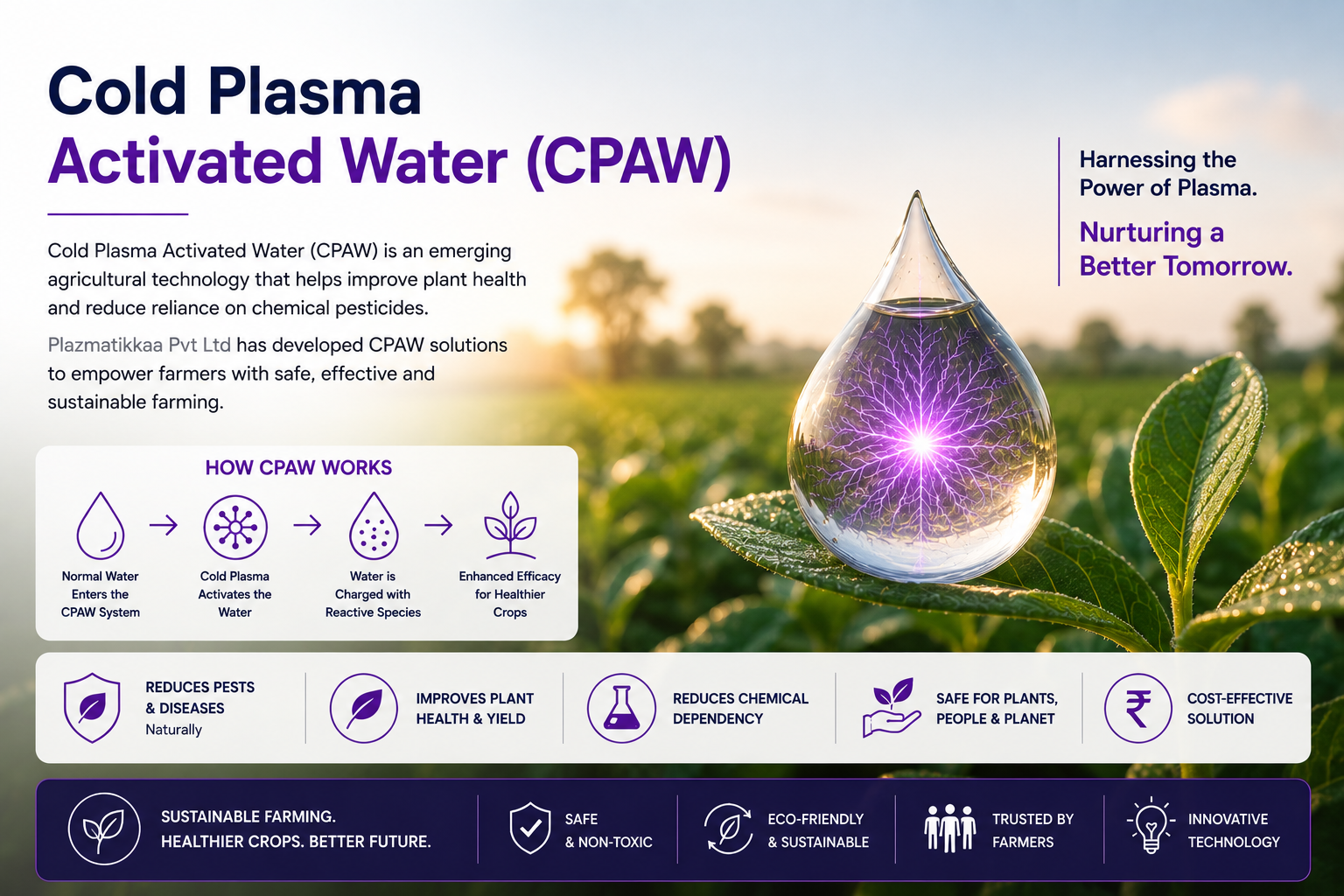
Cold Plasma Activated Water (CPAW) is an emerging agricultural technology that helps improve plant health and reduce reliance on chemical pesticides. Plazmatikaa Pvt Ltd has developed a CPAW Gun that can be attached to existing foliar spray pumps (manual, battery, or tractor sprayers), allowing farmers to adopt plasma-based farming without changing their current equipment.
Agriculture today faces a dual challenge - increase productivity while reducing chemical intensity.
Farmers and agribusiness leaders are actively searching for solutions that improve plant health,
reduce pesticide dependence, and align with sustainability goals.
Cold Plasma Activated Water (CPAW) is emerging as one such technology.
At Plazmatikaa Pvt Ltd, we have developed a CPAW Gun that can be attached directly to existing
foliar spray pumps — including manual, battery, and tractor-mounted sprayers — enabling farmers
to adopt plasma agriculture without changing their spraying infrastructure.
What Makes Our System Different
Our CPAW Gun delivery system is designed not only to generate plasma-activated water, but to
control how effectively it interacts with the plant surface. Our delivery system generates plasmaactivated water and sprays it as:
1. ~30 micron electrostatically charged droplets
2. Negatively charged water molecules
3. Fine mist enabling uniform leaf coverage and stomatal-level contact
Because droplets carry electrostatic charge, they:
1. Spread uniformly across leaf surfaces
2. Adhere to waxy cuticles and complex canopy structures
3. Reduce runoff losses
4. Improve surface interaction time
5. Enhance biological activity at the leaf interface
Bio-Active Components Delivered
During plasma activation, interaction of air and water molecules forms biologically active dissolved
compounds, including:
1. Nitrites (NO₂⁻) and nitrates (NO₃⁻) in low ppm range (~10–20 ppm typical)
2. Hydrogen peroxide (H₂O₂) in controlled concentrations
3. Short-lived reactive oxygen and nitrogen species
Application Efficiency and Reduced Chemical Input
Because these compounds are delivered via electrostatically adhered micro-droplets, they act
directly at the leaf surface rather than only through soil uptake pathways.
When pesticides or plant growth regulators are applied through the CPAW attachment, improved
deposition efficiency allows comparable biological response with reduced input intensity,
depending on crop and formulation.
In this way, the system acts as an application efficiency enhancer — optimizing how molecules
are used rather than changing the chemistry itself.
Functional Advantage:
The combination of electrostatic deposition + reactive aqueous chemistry enables:
1. Efficient leaf-level interaction
2. Nitrogen signalling response in plants
3. Surface microbial suppression
4. Support for plant physiological activity
This positions the system as a precision canopy activation technology, complementing
conventional fertilizers and crop protection practices rather than replacing them.
What Exists Inside Plasma Activated Water?
During activation, cold atmospheric plasma interacts with air and water molecules and forms:
Reactive Oxygen Species (ROS)
Hydrogen peroxide and oxidative radicals
Reactive Nitrogen Species (RNS)
Nitrites & nitrates (~10–20 ppm, typically ~15 ppm)
These are not bulk fertilizers — they act as biological signalling molecules.
Observed Plant Response
Field observations show noticeable effects:
1. Improved leaf greenness
2. Faster recovery after stress
3. Uniform canopy development
4. Early vigour enhancement
Low-dose reactive nitrogen interacts directly at the leaf interface rather than soil pathways,
improving utilization efficiency while minimizing environmental loading.
Hygiene & Protection Function
Reactive species also interact with microbial cells.
This leads to:
1. Suppression of fungal activity
2. Reduction of bacterial contamination
3. Lower soft-body insect persistence on leaf surfaces
Unlike pesticides, the reactive species naturally revert back to water and dilute nitrates after
action.
Why It Matters?
CPAW is not a fertilizer.
CPAW is not a pesticide.
It is a biophysical crop support technology — a new category of agricultural input delivered
through equipment rather than chemicals.
It works as a complement to existing practices while reducing dependency intensity.
Strategic Opportunity
Plasma agriculture opens multiple future pathways:
1. Residue-aware cultivation
2. Input optimization programs
3. Controlled environment farming
4. Export quality production systems
Plazmatikaa Pvt Ltd is focused on making plasma technology practical and scalable through fieldready generation and delivery systems.
We welcome collaboration with:
Researchers | Agribusiness | OEM manufacturers | Institutional farms | Investors